Embedded-finance provider tracked in the Embedded Finance Index — disclosed by 4 companies across 2 categories.
Claim this profile. Work at Atome? Verify your work email to unlock the full buyer list.
Atome started as Southeast Asia's leading BNPL platform under Apaylater Financials (part of Advance Intelligence Group). After securing MAS Major Payment Institution licensing in 2023, it expanded beyond 3-payment installment BNPL into broader consumer credit — launching the Atome Card 'Pay Later Anywhere', savings, lending, and insurance products across Singapore, Malaysia, Philippines, and Indonesia. Successive debt raises (US$200M→US$345M) signal a strategic shift from pure BNPL into a regional digital consumer finance platform.
Other PSP providers in the index, by the number of companies that disclose them. A count of public disclosures, not a ranking of the products.
An embeddable badge for Atome’s own site — it always shows this page’s current rank, so it stays accurate as new disclosures land. States its own denominator; never claims a number this page doesn’t.
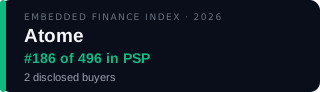
<a href="https://www.embeddedfinanceindex.com/vendors/atome?ref=badge">
  <img src="https://www.embeddedfinanceindex.com/api/badge/atome.svg"
       alt="Ranked #196 of 528 in PSP — Embedded Finance Index 2026">
</a>
<img src="https://www.embeddedfinanceindex.com/api/badge/atome/install" width="1" height="1" alt="" style="display:none">4 companies are linked to Atome in the Embedded Finance Index 2026, through their own public disclosures or Atome's published customer list, including SHOPLINE, Saturday Club, Asiapay and HipVan.
Atome is an embedded-finance provider in PSP and Lending. It ranks #196 of 528 PSP providers by linked companies.
The most-named PSP alternatives to Atome are Stripe (782 buyers), Adyen (317 buyers), PayPal (153 buyers), Checkout.com (114 buyers), Worldpay (88 buyers) and Mollie (63 buyers).
Atome is founded in 2019 and headquartered in Singapore.
Get a read on where your own stack stands against Atome and the rest of its category — what they built versus bought, which providers they use, and where the gaps in your own strategy and competitive set actually are.