Embedded-finance provider tracked in the Embedded Finance Index — disclosed by 7 companies across 2 categories.
Claim this profile. Work at Brale? Verify your work email to unlock the full buyer list.
Brale was founded in 2022 to reduce the cost and complexity of launching regulated stablecoins. It bundles MSB licensing, banking rails (ACH/wire/RTP + virtual accounts), custody, KYB/AML, and multi-chain deployment into one operated platform, positioning itself as the 'Stripe for stablecoins' for payments platforms, fintechs, tokenization projects, and blockchain ecosystems. Notable programs on the platform include Coinflow (cfUSD), Rain (rUSD-backed cards), Canton Network, and SquareFi.
Other Crypto / Stablecoin providers in the index, by the number of companies that disclose them. A count of public disclosures, not a ranking of the products.
An embeddable badge for Brale’s own site — it always shows this page’s current rank, so it stays accurate as new disclosures land. States its own denominator; never claims a number this page doesn’t.
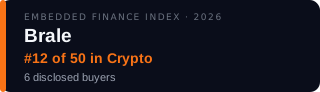
<a href="https://www.embeddedfinanceindex.com/vendors/brale?ref=badge">
  <img src="https://www.embeddedfinanceindex.com/api/badge/brale.svg"
       alt="Ranked #11 of 57 in Crypto / Stablecoin — Embedded Finance Index 2026">
</a>
<img src="https://www.embeddedfinanceindex.com/api/badge/brale/install" width="1" height="1" alt="" style="display:none">7 companies disclose Brale in their stack in the Embedded Finance Index 2026, including Coinflow, Glo Foundation, Etherfuse, Ethereum Classic, Merit, Canton Network and Borderless.xyz.
Brale is an embedded-finance provider in Crypto / Stablecoin and FX / Payouts. It ranks #11 of 57 Crypto / Stablecoin providers by disclosed buyers.
The most-disclosed Crypto / Stablecoin alternatives to Brale are Zero Hash (25 buyers), Circle (23 buyers), Bridge (17 buyers), BVNK (13 buyers), Fireblocks (12 buyers) and Tempo (12 buyers).
Brale is founded in 2022 and headquartered in Des Moines, Iowa.
Get a read on where your own stack stands against Brale and the rest of its category — what they built versus bought, which providers they use, and where the gaps in your own strategy and competitive set actually are.