Embedded-finance provider tracked in the Embedded Finance Index — disclosed by 2 companies across 1 category.
Claim this profile. Work at unit21? Verify your work email to unlock the full buyer list.
Unit21 started in 2018 as a no-code transaction monitoring and case-management platform for fintechs and sponsor banks. It has since expanded from rules-based transaction monitoring into a full 'AI Risk Infrastructure' platform spanning fraud, AML, sanctions/payment screening, customer risk rating, and automated regulatory filing (SAR/CTR/goAML). The current strategic bet is agentic AI — configurable AI agents that not only detect suspicious activity but also run L1 triage, draft SAR narratives, and close the full financial-crime lifecycle.
Other KYC providers in the index, by the number of companies that disclose them. A count of public disclosures, not a ranking of the products.
An embeddable badge for unit21’s own site — it always shows this page’s current rank, so it stays accurate as new disclosures land. States its own denominator; never claims a number this page doesn’t.
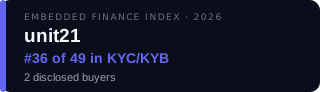
<a href="https://www.embeddedfinanceindex.com/vendors/unit21?ref=badge">
  <img src="https://www.embeddedfinanceindex.com/api/badge/unit21.svg"
       alt="Ranked #52 of 66 in KYC — Embedded Finance Index 2026">
</a>
<img src="https://www.embeddedfinanceindex.com/api/badge/unit21/install" width="1" height="1" alt="" style="display:none">2 companies are linked to unit21 in the Embedded Finance Index 2026, through their own public disclosures or unit21's published customer list, including Lili Bank and Greendot.
unit21 is an embedded-finance provider in KYC. It ranks #52 of 66 KYC providers by linked companies.
The most-named KYC alternatives to unit21 are Sumsub (43 buyers), Persona (36 buyers), Veriff (35 buyers), Onfido (34 buyers), Stripe (24 buyers) and Socure (23 buyers).
unit21 is founded in 2018 and headquartered in San Francisco, CA, United States.
Get a read on where your own stack stands against unit21 and the rest of its category — what they built versus bought, which providers they use, and where the gaps in your own strategy and competitive set actually are.